PediatricWorkflow Copilot
Solving administrative burnout and cognitive diagnostic error.Enabling faster results for families.
We don't replace, we empower
The Radiology Bottleneck.
Capacity Saturation
The Macro Problem: Hospitals are limited by the number of scans a human radiologist can safely review in a shift. This "human cap" creates backlogs, delays treatment, and limits the total number of patients a hospital can serve.
THEORY: By drastically reducing read-time per image, Raylence aims to unlock latent hospital capacity and increase case volume.
Manual Latency
The Micro Problem: Radiologists waste minutes on manual tasks—measuring lesions, calculating volumes, and cross-referencing priors. These "mechanical" tasks reduce the time available for actual diagnosis.
- Manual lesion measurement
- Volume calculation
- Report transcription
THEORY: Automating quantification allows the physician to focus purely on visual search and judgment.
Cognitive Load
The Human Limit: After hours of reading complex scans, the human eye fatigues. Subtleties like millimeter-sized nodules or incidental findings are missed not due to lack of skill, but due to biological exhaustion.
THEORY: A non-fatigable 'Second Reader' that maintains 100% vigilance for subtle feature detection.
Why specifically pediatric?
Children are not miniature adults. Their anatomy is in constant flux, creating a data variance that breaks standard AI models.
Anatomical Variance (0-17Y)
A 2-year-old's chest cavity is fundamentally different from a 12-year-old's. Rapid developmental changes mean "normal" is a moving target. Raylence is calibrated to detect pathology across this shifting baseline.
Radiation Sensitivity (ALARA)
Pediatric tissue is highly radiosensitive. Retakes are not an option. Our "First-Pass Quality" algorithms ensure images are diagnostic immediately, adhering strictly to the ALARA (As Low As Reasonably Achievable) principle.
The Data Scarcity Gap
99% of medical AI is trained on adult datasets. This bias leaves pediatric care behind. We are building the foundational model specifically for the developing body.
Adult models interpret growth plates as fractures. They flag the thymus as a mass. They miss the subtle signs that only appear in developing bodies.
Raylence is designed exclusively for ages 0-17 to recognize ossification centers, normal thymus variants, and the developmental nuances that define pediatric radiology.
The Dual-Engine Architecture.
Standard AI looks at the whole image at once, missing tiny details. Raylence runs two neural networks in parallel.
1. Global Transformer
Context AwarenessAnalyzes the entire X-ray to understand general anatomy (heart size, lung inflation) and patient positioning. It establishes the "baseline" of the image.
2. Vision Transformer
Fine-Grained AttentionTreats image patches as sequences, applying self-attention to capture long-range dependencies. It detects subtle anomalies like micro-fractures or early consolidation that traditional convolutions might overlook.
The Data Pipeline
The Trigger
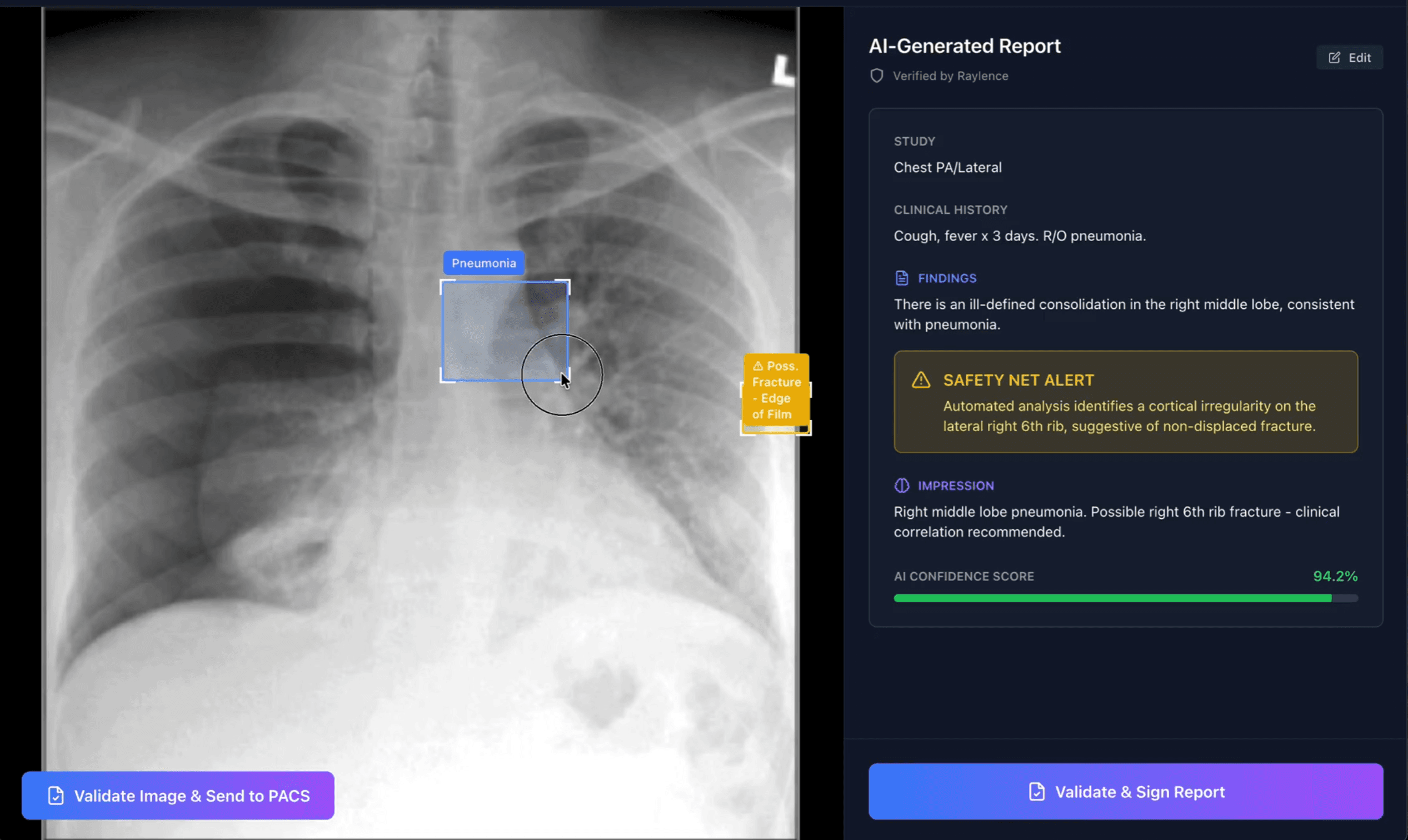
Radiologist opens study in existing PACS. No workflow interruption. Raylence activates silently in the background via standard integration protocols.
The Engine
Data routed to Raylence servers for instant processing. Pediatric-specific foundation models analyze anatomical landmarks, detect pathologies, and draft reports in parallel.
The Result
Structured report and safety findings delivered within seconds. Ready for radiologist validation and sign-off.
FAQ
Get in Touch
Have any questions? Send us a message and we'll get back to you as soon as possible.